

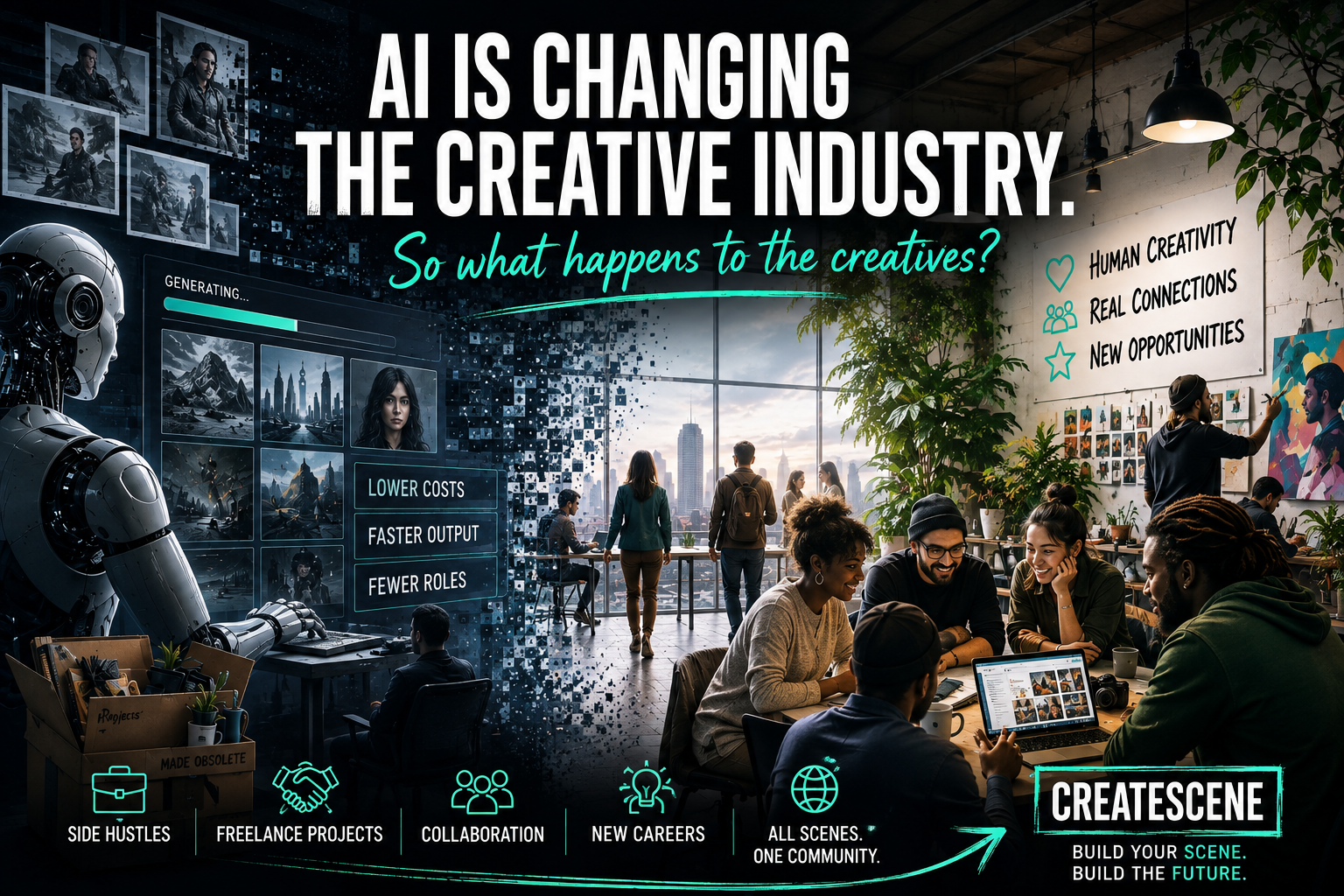
Artificial intelligence is rapidly becoming part of the creative process, but as the technology becomes more capable, it is likely to change far more than the tools we use. It could reshape creative careers themselves. If permanent jobs become fewer, freelance work increases and more people need to build multiple sources of income, the creative industry may need a new kind of infrastructure built around people, collaboration and community.
Every generation of creatives has watched technology change the way their industry works. Photographers moved from darkrooms to Photoshop, illustrators from drawing boards to Illustrator and Procreate, musicians from analogue studios to laptops, and filmmakers from physical film to digital cameras and editing suites that can now fit inside a backpack. Each transition created anxiety about what might be lost, but it also gave creative people tools that made previously complicated, expensive or inaccessible forms of creativity available to far more people.
Artificial intelligence deserves to be considered within that history. There is a version of the AI revolution that is genuinely exciting for the creative industries. Used as a tool rather than a replacement, AI can help someone explore ideas more quickly, develop concepts, research subjects, create storyboards, organise projects, remove backgrounds, clean audio, generate variations, translate content, automate administration and tackle dozens of repetitive tasks that take creative people away from the part of their work they actually enjoy. A designer using AI does not suddenly stop being a designer any more than using Photoshop stopped someone being a photographer. The technology can become another part of the creative process.
The difference is the scale of what is beginning to happen.
Photoshop could make a photographer more capable, but it couldn't independently respond to a brief and produce hundreds of plausible images in seconds. Final Cut made editing faster, but it couldn't generate an entire video from a written description. Illustrator transformed graphic design, but it didn't allow someone with virtually no design experience to request a logo, poster or advertising concept and receive something usable almost instantly. Generative AI is unusual because it doesn't only automate the mechanical parts of creative work; increasingly, it can participate in parts of the process we previously considered creative.
That distinction matters because businesses don't need AI to completely replace a profession for it to have a significant effect on employment. It only needs to change how much human labour is required to produce the same amount of work.
Imagine a creative department that once required ten people. If AI allows those ten people to produce twice as much, that's fantastic for the people using the technology today. But when somebody leaves, does the company replace them? When the department grows, does it hire five more people, or does it ask the existing team to produce more with AI? Could a company eventually operate with six permanent employees and commission specialists only when a project requires skills the internal team doesn't have?
That is where the conversation becomes much more complicated than simply asking whether AI will "take our jobs".
Creative work may not disappear. It may fragment.
The evidence increasingly suggests that AI's effect on employment will be a mixture of creation, displacement and transformation rather than a simple mass replacement of humans.
The International Labour Organization's 2025 research into generative AI and employment found that one in four workers globally is already in an occupation with some degree of exposure to generative AI. Importantly, the ILO concluded that transformation is currently more likely than complete redundancy because most occupations still require significant human input. However, it also found that improvements in AI's ability to generate images, video and voice have increased automation scores specifically across a range of media and web-related occupations.
For creatives, therefore, the biggest immediate change may not be the disappearance of creativity as a profession. It could be a change in the shape of a creative career.
Companies will still need branding. Films will still need making. Products will still need photographing. Businesses will still need websites, campaigns, music, illustration, animation, content and ideas. What may change is how much of that work is carried out by permanent internal teams and how much is commissioned when required.
A business that previously employed several specialists might retain a smaller multidisciplinary team equipped with AI tools, then bring in a photographer for a campaign, an illustrator for a launch, an animator for a video or a musician for a particular project. The work still exists, but the employment relationship surrounding it changes.
That could accelerate something already familiar to creative people: the portfolio career.
Instead of having one employer and one job title, more people may find themselves combining several different ways of earning a living. A graphic designer might work three days a week for an agency while freelancing for two clients, selling prints online and teaching a workshop once a month. A musician might perform, produce for other artists, create music for brands and teach. A photographer might combine commercial shoots, events, content creation and filmmaking. Someone who has never previously considered themselves a professional creative might use evenings and weekends to build a second income around a skill they previously regarded as a hobby.
For some people that freedom will be exciting. For others it will be a transition they never asked for.
And that distinction is important.
Losing a job means more than losing a salary
When we talk about AI and employment, the conversation often becomes dominated by numbers: how many jobs will disappear, how many will be created and how productive workers might become. Those numbers matter, but they can obscure the human experience behind them.
A job gives somebody more than money. It can provide routine, confidence, colleagues, friendships, identity, progression and the feeling that their abilities are useful to somebody else. For creative people in particular, our work often becomes closely intertwined with how we understand ourselves.
Being told that technology can now perform part of something you spent ten or twenty years learning to do isn't simply an economic event. It can be deeply personal.
And this is why the optimistic statistics around new job creation don't completely solve the problem.
Even when technological change ultimately creates more employment than it destroys, the person whose job disappears on Monday does not automatically step into one of those new careers on Tuesday. New jobs may require different skills, exist in different places or operate under completely different working arrangements. There is a transition between the old economy and the new one, and millions of individual people have to navigate it.
For the creative industries, community could become incredibly important during that transition.
People will need somewhere to find opportunities, but they will also need somewhere to find each other.
Human creativity isn't becoming worthless
There is a temptation to interpret increasingly capable generative AI as evidence that human creativity itself is becoming less valuable. I think the opposite may ultimately be true.
Producing something and having something worth saying are not the same thing.
AI can generate a thousand images, but quantity doesn't create taste. It can write thousands of songs, but technical competence doesn't guarantee that somebody will care about them. It can generate advertisements, articles, videos and designs, but culture has never simply been a competition to see who can produce the greatest volume of content.
Creativity comes from lived experience. It comes from childhood, relationships, heartbreak, obsession, humour, anger, curiosity, community, failure, politics, identity and the strange collection of experiences that make one person's view of the world different from somebody else's.
Technology can imitate the outputs of that process increasingly convincingly. That doesn't mean it has lived the life that created them.
There is also evidence that employers continue to value precisely these human capabilities. The World Economic Forum's Future of Jobs Report 2025 identifies creative thinking among the skills expected to continue increasing in importance towards 2030. Its wider forecast anticipates substantial disruption across the labour market, with 92 million existing jobs displaced but 170 million new roles created by 2030. That would represent a net increase in employment, but an enormous amount of movement between occupations along the way.
That movement is the part I find particularly interesting.
Because if millions of people are going to need to adapt, retrain, freelance, collaborate or create entirely new careers, then perhaps the creative economy needs better ways of helping people make those transitions.
There is another uncomfortable side to the AI boom
Creative people have also spent the last two decades pouring an extraordinary amount of human creativity into digital platforms.
We've uploaded our photography, artwork, writing, videos, music, designs, conversations, ideas and personal experiences. We did so because these platforms promised something valuable in return: an audience, connection, discovery and opportunity.
Generative AI has complicated that relationship considerably.
Questions surrounding what material can legitimately be used to train AI systems, whether creators should be able to opt out, how copyright should apply and whether compensation should be required remain fiercely contested. But whatever position somebody takes on those debates, it is understandable that creatives feel uncomfortable watching technology become capable of competing with them after being developed using enormous quantities of human-created material.
The economic stakes are potentially significant. A global study commissioned by CISAC, which represents more than five million creators through its member societies, estimated that under current market and regulatory conditions as much as 24% of music creators' revenues and 21% of audiovisual creators' revenues could be at risk by 2028 as generative AI outputs compete with human-created work. The study estimated a cumulative €22 billion of creator revenues at risk over five years. These are forecasts rather than certainties, but they demonstrate why concerns within creative communities cannot simply be dismissed as resistance to technological progress.
CISAC Board Chair Marcelo Castello Branco described the difference particularly well when he said that previous technologies changed the industry's distribution channels, while generative AI reaches "the very core of the creative process."
That doesn't mean creatives should reject AI. It means we should think seriously about the digital ecosystems we build around it.
This is the future we're building CreateScene for
CreateScene wasn't created as an anti-AI platform, and I don't want it to become one.
I'm an artist and a founder. I use technology. I'm excited by technology. I believe AI will become an incredibly useful part of the creative toolkit, just as countless technologies before it have become inseparable from modern creative work.
But I also believe the next decade could leave a lot of creative people searching for something.
For some, that will be their next full-time career. For others, it will be their first freelance client. Someone else might need a second income because their hours have been reduced. Another person might finally decide to turn the thing they make at weekends into a business. An experienced designer may need to reposition themselves as a consultant. A filmmaker may need collaborators for a project. A musician might need an animator. A photographer might meet a fashion designer and together create something neither would have produced independently.
Those connections are difficult for AI to replace because the value isn't simply in matching two skills. It is in what happens when two human beings with different experiences, ideas, personalities and creative instincts start talking.
That is the future we want CreateScene to help enable.
We want different creative scenes to exist alongside each other rather than in separate silos, because increasingly the most interesting creative opportunities sit between disciplines. Musicians need photographers. Artists need filmmakers. Brands need illustrators. Game developers need composers. Fashion designers need models. Startups need designers. Events need performers. Creatives need other creatives.
The more fragmented employment becomes, the more valuable those connections could become.
CreateScene can become somewhere you go when you want to find your next project, but also somewhere you discover the person who helps you create one.
It can be somewhere to launch a freelance career, test a side hustle, sell something you've made, offer a service, discover opportunities, find collaborators or simply become part of a community of people trying to build creative lives of their own.
That feels increasingly important in a world where more of our working lives may become independent.
We shouldn't wait for the future to be built for us
Nobody knows exactly what AI will do to the creative industries over the next decade, and anyone claiming otherwise is guessing.
Some predictions will prove wildly pessimistic. Others may prove nowhere near pessimistic enough. New creative professions will appear that barely exist today, just as social media managers, YouTubers, app designers, podcast producers and digital creators would have sounded like strange career choices a generation ago.
What seems much more certain is that change is coming.
The ILO's conclusion is probably the most useful way of thinking about it: for most people, AI is more likely to transform jobs than simply eliminate them. Transformation, however, still requires people to transform with them.
That means learning new skills. Trying new tools. Building relationships. Finding different sources of income. Becoming more comfortable with freelancing. Collaborating across disciplines. Turning hobbies into businesses. Starting projects. Helping each other find work. And sometimes completely reinventing what a creative career looks like.
Technology will play an enormous role in that future, but we shouldn't allow technology companies to be the only people deciding what the future of creativity looks like.
Creatives should have a say in it too.
That's ultimately why I believe in what we're building with CreateScene. Not because AI is going to destroy creativity, but because the period of change it creates could make community, collaboration and human connection more important than ever.
If the future means more of us becoming independent, then we need better ways to find one another. If careers become less linear, we need better ways to discover opportunities. If creative teams become smaller, we need better ways for businesses to find specialists. If more people need second incomes, we need better ways for them to turn their abilities into opportunities. And if technology makes creating content almost infinitely easy, then genuine human relationships may become one of the most valuable things a creative platform can offer.
AI is going to become part of creativity. I don't think we should be afraid of that.
But the future of the creative industry shouldn't only be about what machines are capable of creating.
It should also be about what technology can help people create together.
That's the future we're building CreateScene for.