

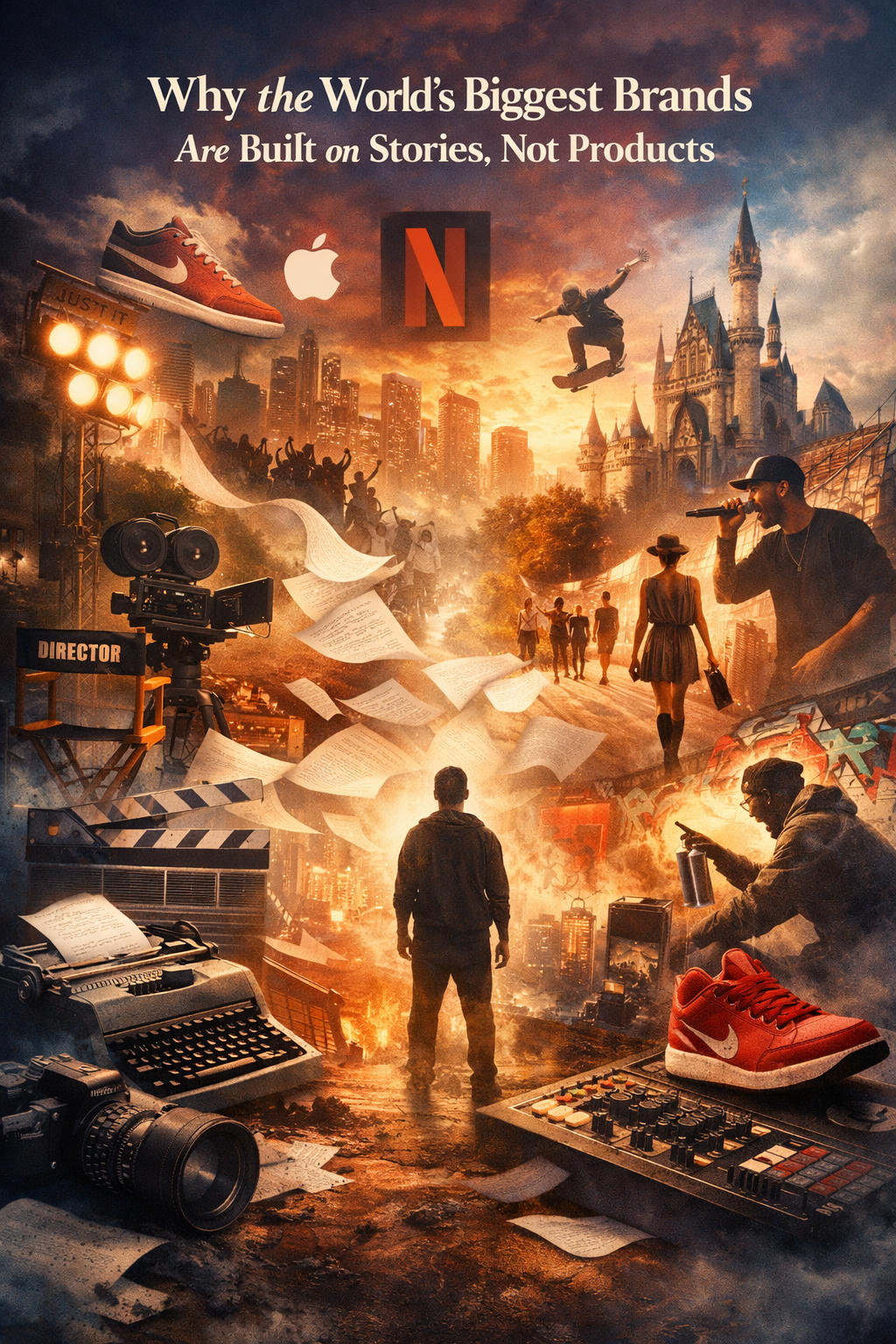
We like to believe we choose things logically.
That we buy one trainer over another because it performs better. That we watch a series because it’s well made. That we follow a brand, an artist, or a movement because it offers something objectively superior.
But scratch beneath the surface and that logic quickly falls apart.
What actually draws us in — what keeps us loyal, emotionally invested, and willing to return again and again — is story.
Long before brands existed, humans told stories to survive. Cave paintings weren’t decoration. They were records, warnings, identities. Stories helped people make sense of chaos, understand each other, and feel part of something larger than themselves.
That instinct never disappeared. It simply evolved.
Today, stories move through trainers, films, albums, artworks, fashion collections, comedy sets, and streaming platforms. The medium changes, but the purpose remains the same: to connect, to belong, to say this is who we are.
The world’s biggest brands didn’t become dominant by accident, and they didn’t do it through product alone. They became powerful because they understood something fundamental — consciously or instinctively — that many still overlook:
storytelling isn’t an accessory to success. It’s the engine behind it.
Netflix is one of the clearest modern examples of this.
In its early years, Netflix wasn’t culturally special. It was a DVD rental company. Then a streaming service licensing other people’s content. Useful, yes — but replaceable. If it had stayed there, it would have remained a utility rather than a cultural force.
Everything changed the moment Netflix stopped thinking like a distributor and started thinking like a storyteller.
Commissioning House of Cards, Orange Is the New Black, and later backing projects that didn’t look, sound or feel traditionally ‘safe’ wasn’t just a content strategy. It was a belief system. Netflix was effectively saying: we trust stories enough to bet everything on them.
That belief reshaped the company. It opened the door to unfamiliar voices, global perspectives and culturally specific narratives. Shows like Squid Game didn’t succeed because they were engineered for mass appeal — they succeeded because they were deeply specific, unapologetic, and honest. Netflix didn’t sand down the edges. It amplified them.
Streaming was just the delivery system. Storytelling was the strategy.
This pattern isn’t unique to Netflix. It’s visible everywhere you look once you know how to recognise it.
Nike doesn’t dominate culture because it makes technically superior trainers. That advantage can be copied. What can’t be copied is the story Nike tells — about effort, resilience, belief and overcoming limitations. From elite athletes to unknown runners, Nike repeats the same narrative endlessly in different forms: you can push further than you think.
Apple doesn’t sell devices. It sells a worldview. Creativity over conformity. Intuition over bureaucracy. Tools for people who want to make, not just consume. From the iconic 1984 advert to the language still used in product launches today, Apple positions itself not as a tech company, but as a cultural ally for artists, outsiders and thinkers.
Disney operates at a different scale, but the same principle applies. Its power doesn’t come from content volume, but from mythology. Characters, worlds and emotional rituals passed from one generation to the next. Parents don’t pass down products. They pass down stories.
Even brands rooted in subculture understand this instinctively. Supreme didn’t grow through mass communication or traditional marketing. It grew by telling a very specific story about place, authenticity and belonging. The product was simple. The narrative did the heavy lifting.
What connects all of these examples isn’t industry or size. It’s conviction.
They knew who they were, what they stood for, and the story they wanted to tell — and they built everything else around that.
Long before brands learned how to do this deliberately, creative scenes were doing it naturally.
Punk wasn’t a genre. It was a story about frustration, class, boredom and refusal. Hip hop wasn’t just music. It was a narrative language for communities documenting their reality when no one else would. Graffiti wasn’t vandalism — it was visibility, identity written onto cities that tried to erase it.
Grime didn’t break through because it was polished. It broke through because it sounded exactly like where it came from — pirate radio, tower blocks, ambition compressed into rhythm. Rave culture spread because it offered an alternative story: temporary freedom, shared experience, escape from rigid structures.
Scenes don’t form around perfect products. They form around shared meaning.
That’s why scenes feel alive. Why they generate influence long before money arrives. They are held together by story — by a collective sense of this is who we are, and this is how we see the world.
Over time, brands arrive. Industries take notice. Aesthetics get copied. But what travels — what endures — is the narrative beneath the surface.
This same instinct runs through every creative discipline.
Artists aren’t selling paint and canvas. They’re offering a way of seeing. Designers aren’t selling clothes. They’re communicating identity, heritage, rebellion and aspiration. Filmmakers shape emotion and memory. Musicians document environments and inner lives. Comedians reveal uncomfortable truths through humour.
Different mediums. Same human drive.
Storytelling is the thread that allows these scenes to speak to each other, influence each other, and evolve together.
In an era obsessed with optimisation — metrics, reach, virality — this matters more than ever. Platforms reward repetition. Trends flatten nuance. Content is often engineered to perform rather than to mean something.
Storytelling cuts through because it refuses neutrality.
A real story has perspective. It risks alienation. It pushes limits. It says this is how I see things, not this is what the algorithm prefers. That’s why culturally specific work continues to break through, even in an increasingly crowded landscape.
The most compelling creators today understand this instinctively. They don’t build audiences through volume alone, but through consistency of voice and worldview. People follow them not just for what they make, but for how they interpret the world.
In that sense, creators are becoming brands — not in a commercial sense, but in a cultural one. Story-first. Belief-led. Rooted in perspective.
And this is where CreateScene comes in.
CreateScene exists because culture doesn’t live in silos. Art, fashion, film, music, comedy, design — these scenes constantly overlap, borrow from each other, and evolve together. What connects them isn’t medium or market. It’s story.
CreateScene isn’t about chasing trends or crowning winners. It’s about giving space to voices from different scenes who have something to say — and letting those stories sit side by side. It’s a stage, not a gatekeeper. A place where collaboration happens naturally because stories resonate across disciplines.
Netflix succeeded because it trusted storytelling enough to take risks. Nike, Apple and others built empires by doing the same. If CreateScene succeeds, it won’t be because of technology alone, but because it inspires a new generation of creators to embrace narrative, push limits, and tell stories with conviction.
Because the future of creativity won’t be built by those who simply make things.
It will be built by those who take responsibility for meaning.
By people who understand that whatever their scene — art, fashion, film, music, comedy, design, technology — they are not just producing output. They are shaping narratives. Challenging assumptions. Expanding what culture can look like and who gets to participate in it.
Storytelling isn’t reserved for writers or filmmakers. It belongs to anyone with a point of view and the courage to express it. Anyone willing to push beyond aesthetics, beyond optimisation, beyond what’s expected.
That’s how Netflix changed the rules. It’s how Nike, Apple and countless movements before them built belief. And it’s how the next generation will do the same — not by copying the surface, but by committing to the story underneath.
CreateScene exists to give those stories a place to collide.
To connect voices across scenes. To encourage collaboration over competition. To remind creators that culture doesn’t move forward through silence or safety, but through conviction.
So wherever you’re creating from — a studio, a bedroom, a stage, a screen, a street — the challenge is the same.
Tell better stories.
Push them further.
And build the future of creativity from the inside out.
The biggest brands in the world weren’t built on products.
They were built on stories.
And the next ones could be written on CreateScene.