
Why Reddit’s Art Meltdown Reveals a Bigger Problem — And Why the Future Belongs to Open Creative Spaces
There’s a moment most artists recognise: that breath-held hesitation before pressing “Post” for the first time. You’ve created something you care about, something you’ve wrestled with, something you’re proud of but still painfully vulnerable about. You hope to connect with someone. You hope to be part of something. You certainly don’t expect to be silenced, scolded, or banned.
Yet in late 2025, thousands of artists across Reddit found themselves facing exactly that.
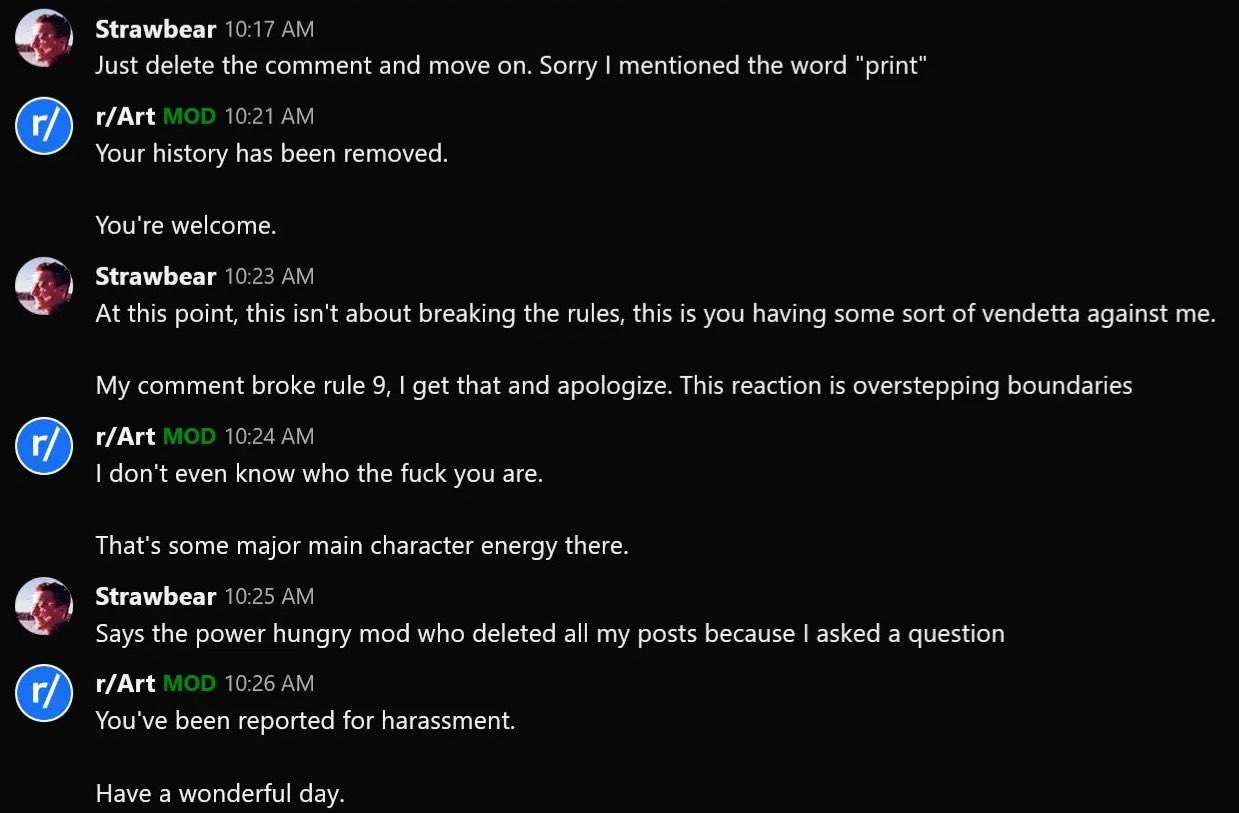
A thread on X went viral after an artist revealed they’d been banned from r/art — a subreddit with more than 22 million members — simply for asking why their submission had been removed. No abuse. No spam. No wrongdoing. Just a quiet, reasonable “Why?”
That screenshot exposed a much bigger truth: Reddit’s moderation system is failing the very creators it claims to support. Posts are being deleted for including links. Artists are being punished for mentioning prints or exhibitions. Entire accounts are being suspended for questioning a moderator’s inconsistent rules.
This isn’t moderation. It’s mismanagement. And for a creative community of that scale, it’s catastrophic.
But this isn’t just about Reddit. It’s about a deeper, structural problem that has crept into modern creative life: the wrong people, and the wrong systems, are acting as gatekeepers. The crisis unfolding in r/art is merely the loudest example of a problem artists have been navigating for years — a problem we can no longer ignore.
The Gatekeepers We Expect — And the Ones We Don’t
Artists grow up knowing certain doors must be knocked on. Galleries curate. Publishers choose what they print. Record labels sign selectively. These decisions are part of the landscape. They’re grounded in investment, identity, and commercial logic. A gallery specialising in pop art won’t hang a brilliant abstract painter, not because of a lack of talent, but because it doesn’t fit their business model. Doors close, others open, and as artists we learn that the world has many thresholds — not one.
This kind of gatekeeping is necessary. It teaches us how markets work, where our voice fits, and how to shape our direction. It’s aspirational rather than punitive.
But online, a different kind of gatekeeping has taken hold — one driven by untrained moderators, inconsistent rules, personal preference, and opaque authority. On Reddit, a handful of volunteers can dictate the visibility of millions. One moderator welcomes external links; another deletes them. One allows process videos; another calls them spam. One embraces newcomers; another treats them with suspicion.
It creates an ecosystem where artists aren’t learning how to grow — they’re learning how to tiptoe.
And beneath this human inconsistency lies something even more invisible: the rise of algorithmic gatekeeping. Instagram suppresses posts that include links. TikTok buries videos that don’t ignite immediate engagement. Facebook shows your work to a fraction of your followers unless you pay. YouTube demonetises based on criteria even creators can’t explain.
In 2024, a Creator Economy Report found that 72% of creators believe algorithms actively limit their reach, and 56% feel punished for directing audiences to their own websites.
The irony is stark. The internet promised creative freedom, yet now functions through systems that quietly restrict it.
And so, between inconsistent moderators and invisible algorithms, artists are squeezed by barriers they never asked for, and certainly never benefited from.
Stories From the Front Lines of a Broken System
If the situation weren’t so damaging, the stories might sound absurd.
One artist had a painting removed because it featured a guitar — apparently more suited to r/music than r/art. Another photographer was accused of posting AI imagery, even after providing the raw files and process shots to prove otherwise. Someone trying to share an exhibition announcement had their work deleted because the link “felt promotional”. A creator watermarked their image to protect it from theft, only to be told the watermark made the post “unacceptable”.
And countless artists have reported the same pattern: inconsistent enforcement, arbitrary removals, and punishments for simply asking for clarity.
One user described posting on Reddit now as “playing roulette with your dignity.”
It’s the emerging, the unknown, the unrepresented — the people who rely most on public forums — who pay the highest price. These communities should be the training ground where artists explore, grow, and connect. Instead, they’ve become obstacle courses.
When visibility is controlled by whims rather than principles, a creative space stops being a community and becomes a hazard.
Why Public Creative Spaces Should Never Function Like Private Gatehouses
A gallery has the right to select. A magazine has the right to curate. A label has the right to choose.
But a community forum is not a gallery. It is a commons — the modern version of an open studio night, a university hallway full of sketchbooks, or a café buzzing with writers swapping ideas. These environments have always been the birthplace of movements and friendships. They work because they are permeable. You don’t need credentials to walk in. You don’t need a certain number of followers, sales, or accolades. You don’t need to tick a specific stylistic box. You just need curiosity and the willingness to contribute.
Look at any flourishing creative era — Paris in the twenties, Soho in the seventies, the Bowery in the eighties. These scenes thrived not because of gatekeeping, but because people could walk into the same room and collide with the unexpected. The painter met the poet. The graffiti artist met the curator. The filmmaker met the musician. The cross-pollination was the magic.
Modern platforms claim to support this spirit while quietly sabotaging it.
Reddit, with its siloed moderators and inconsistent enforcement, breaks that permeability. Instead of one open space, it becomes a corridor of closed doors — each with different rules, different moods, and different punishments. It trains artists not to share, but to second-guess.
And when artists hesitate, culture withers.
Visibility Isn’t Self-Promotion — It’s Survival
There is a myth among certain moderators that artists must be “protected” from self-promotion — as if promoting your own work contaminates the purity of a community. But this belief is deeply out of touch with the reality of creative life.
Artists are not hobbyists dabbling for validation. Artists are creators, entrepreneurs, small businesses, communicators, and cultural contributors. Sharing your prints, your exhibitions, your socials, or your opportunities isn’t spam — it’s part of sustaining a career. Removing those opportunities doesn’t preserve the integrity of a space. It drains it.
The healthiest creative communities throughout history have been places where people shared their work, named their shows, invited others in, and celebrated each other’s progress. Visibility is not arrogance. Visibility is oxygen.
To punish it is to misunderstand what creativity requires.
Why CreateScene Offers a Different Path Forward
CreateScene was built with a simple but radical principle: creative communities should be open, consistent, and structured around shared interests — not gatekept by inconsistent authority.
When you join CreateScene, you enter a landscape of scenes representing specific areas of creative culture — street art, illustration, photography, sculpture, tattooing, fashion, writing, design, performance, and countless others. Each scene functions under the same framework. No shifting rulebooks. No localised power struggles. No individual moderators imposing personal taste.
You join a scene because it reflects your interest, your craft, or your identity — and once you're there, you’re free to contribute. You can share work, progress, exhibitions, links, advice, opportunities, or collaborations. You can promote responsibly without being punished for simply existing as a working artist. You can connect with others who share your passions, and you can explore the work of thousands without invisible systems throttling what you see.
The only boundary is a universal moral baseline that applies equally everywhere. Beyond that, the doors stay open.
Where Reddit creates friction, CreateScene creates flow.
Where Reddit imposes inconsistency, CreateScene offers stability.
Where Reddit punishes visibility, CreateScene encourages it.
It is a return to what communities should be: ecosystems, not obstacles.
A Moment of Choice for the Creative World
What is happening on Reddit is not a minor controversy. It’s a signpost. A cultural warning. A reminder that the digital environments we rely on require scrutiny, transparency, and respect for the people who keep them alive.
We can no longer pretend that platforms not built with creators in mind will suddenly evolve to protect and nurture them. We cannot keep handing our careers and connections to systems that silence ambition, suppress visibility, and empower unqualified gatekeepers.
Artists deserve better.
Communities deserve better.
Creativity deserves better.
And the future will belong to the spaces that recognise this.
Platforms like CreateScene exist because the creative world needs a home built on openness rather than restriction, consistency rather than chaos, and empowerment rather than punishment. A place where artists don’t have to apologise for wanting to be seen, and where sharing your work is celebrated rather than policed.
Creativity has never been about closing doors. It has always been about opening them.
And the next chapter of creative culture will be written by the communities brave enough to keep those doors unlocked.